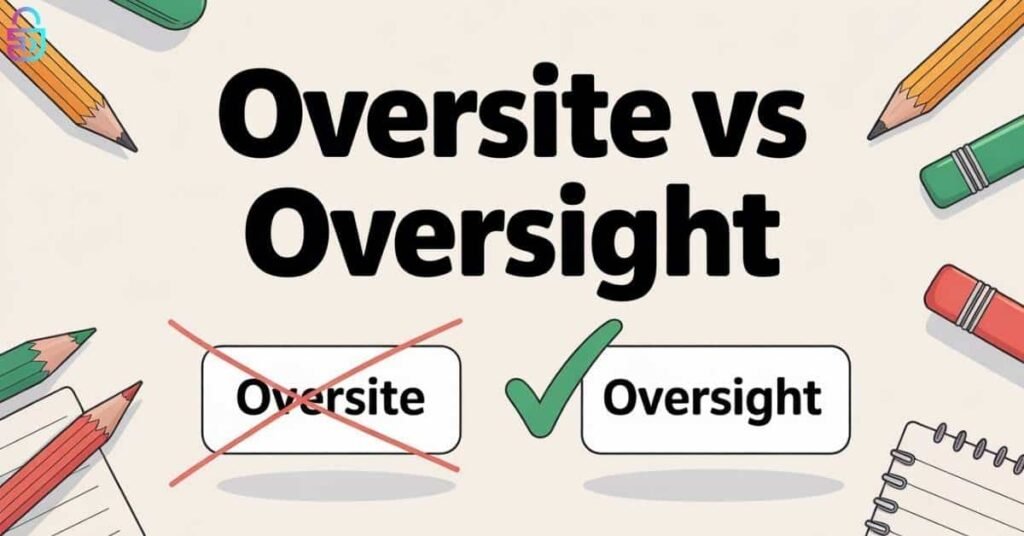
Language can be tricky because some words look almost identical, yet they belong to very different meanings, contexts, and writing habits. Oversight is a common English word with two major senses: it can mean supervision or responsible watchfulness, and it can also mean an accidental mistake or omission. Major dictionaries such as Merriam-Webster, Cambridge, Oxford, Britannica, and Dictionary.com all reflect these core meanings.
Oversite is different. It is not the standard everyday choice when you mean supervision or a mistake. In niche usage, it appears as a construction term for a concrete layer under a floor or slab. That is why many readers confuse the two, even though they belong to different contexts.
The practical question behind Oversite vs oversight is simple: which word fits your sentence, your audience, and your meaning? That is the real skill. A writer does not merely pick a spelling; a writer picks clarity. When the wrong word lands in a headline, email, report, or blog post, the whole message can feel less trustworthy, even if the mistake is small.
Meta at a Glance
Before the full guide, here is the quick reference that many readers need right away.
Primary meaning:
Oversight = supervision or a mistake.
Niche meaning:
Oversite = a construction-related term for a concrete layer beneath a floor.
Best everyday choice:
Use oversight in most writing.
Common risk:
Using oversite when you really mean oversight.
Why This Pair Causes Confusion
Words like these are confusing because English often preserves old spellings, borrowed forms, and specialized terms that overlap in appearance. To the eye, “oversite” and “oversight” seem close enough to be interchangeable. To the reader, however, they are not.
This confusion is especially common in fast writing. People type quickly, rely on memory, and trust autocorrect too much. When that happens, a word that looks “about right” may slip into the sentence without anyone noticing. The result is a sentence that may still be understandable, but not polished.
There is also a second reason the pair causes trouble: oversight has more than one meaning. It can describe management, supervision, or control, but it can also describe an error caused by not noticing something. Merriam-Webster and Cambridge both show these dual uses clearly.
That dual meaning makes the word useful, but it also makes it easy to misuse. Readers often infer the wrong sense if the surrounding sentence is weak. Strong context solves that problem. So does choosing the correct form from the start.
What “Oversight” Means in Modern English
The word oversight is widely used in formal writing, business communication, government, journalism, and everyday speech. Its meanings are straightforward.
Supervision or responsible control
This meaning appears when someone is responsible for watching over a process, project, department, or institution. Dictionaries describe it as management, supervision, or careful control. Cambridge and Merriam-Webster both include this sense.
Examples:
- The manager provided oversight of the project.
- The board has oversight of policy decisions.
- Strong oversight can improve quality and accountability.
An accidental mistake or omission
This is the second common sense. In this case, oversight means an error caused by not noticing something, forgetting something, or failing to include something. Oxford, Britannica, and Dictionary.com all list this meaning.
Examples:
- Leaving her name off the list was an oversight.
- The missing attachment was a simple oversight.
- The wrong date was printed because of an oversight.
This is why Oversite vs oversight is not just about spelling. It is about meaning, audience, and context. The same word can point in two directions, so the sentence around it must do some work.
What “Oversite” Means and Why It Is Rare
Oversite is much less common in general writing. In construction-related references, it appears as a term for a layer of concrete under a ground floor or slab. Wiktionary and OED snippets show this specialized usage.
That matters because many people who search for “oversite” are not looking for construction language at all. They usually mean “oversight.” In other words, the search term may be genuine, but the intended word is often different.
So in practical editing, the rule is simple:
If you are talking about supervision, responsibility, or a mistake, use oversight.
If you are talking about a construction context and a concrete base layer, oversite may be the right specialized term.
This distinction is the heart of Oversite vs oversight. One word is general and widely used; the other is niche and context-specific.
How to Choose the Right Word
A useful way to decide is to ask a single question: “Am I writing about watching over something, or about a mistake I made?”
If the answer is yes, use oversight.
If you are describing:
- leadership responsibility,
- regulatory review,
- project supervision,
- a missed detail,
- a forgotten task,
- or an unintentional omission,
then oversight is the right choice. Merriam-Webster and Cambridge both support those meanings.
If you are writing about:
- floors,
- slabs,
- concrete layers,
- or a building base,
then the construction term oversite may apply.
A simple memory trick
Think of oversight as “seeing over” something. That helps you remember the supervision meaning. The mistake meaning is also easy to connect: if you did not see it, it became an oversight.
Think of oversite as “site” language. It belongs closer to building, ground, and construction than to business writing or general grammar.
Practical Examples You Can Use
The best way to learn a language choice is through examples. Here are clean, natural uses of the correct form.
Correct uses of oversight
- The committee will have oversight of the budget.
- The editor noticed an oversight in the draft.
- The company apologized for the oversight.
- The school board must maintain oversight of safety procedures.
These sentences align with dictionary definitions of supervision and mistake.
Incorrect or less suitable uses
- The manager will have oversite of the budget.
- The report contained an oversite.
- It was just a small oversite in the draft.
In normal writing, these are usually wrong unless you are deliberately using a construction term or quoting specialized text. For most readers, they look like spelling errors.
Construction-related use of oversite
- The oversite layer was prepared before the floor finish was installed.
- The contractor checked the oversite concrete before proceeding.
These examples reflect the specialized building sense shown in niche references.
How Writers Can Avoid the Mistake
The easiest fix is to slow down at the moment you type the word. That may sound simple, but many writing problems are solved by a small pause.
Read the sentence out loud
If the sentence sounds like supervision, control, or correction, use oversight. If it sounds like floor construction, use oversite.
Check the surrounding nouns
Words like committee, project, manager, policy, regulation, and review point toward oversight.
Words like slab, floor, concrete, and foundation point toward oversite.
Use a style habit
A good editing habit is to scan for similar-looking words after you finish a draft. This works especially well in business writing, where small mistakes can weaken credibility.
Let context lead
Most readers decide meaning from context first and spelling second. So the real problem is not only the word itself, but the sentence around it. Strong context protects you from confusion.
This is one reason Oversite vs oversight keeps appearing in writing guides, grammar discussions, and search queries. The pair is small, but it has a big effect on how polished the page feels.
Why Oversight Matters in Professional Writing
In professional communication, word choice signals care. A reader who sees the correct term in the correct place tends to trust the rest of the message more readily. A reader who sees a confusing term may slow down, reread, or mentally question the writer’s precision.
That is especially true in:
- business reports,
- academic work,
- internal memos,
- policy notes,
- blog posts,
- and public-facing content.
In these settings, oversight is often the better word because it is recognized, standard, and clear. Dictionaries describe it as both supervision and an unintentional error, so it serves a wide range of formal and informal uses.
Oversite, by contrast, is specialized. It belongs in construction writing, not in most other contexts. That narrow use is exactly why the pair can trip up even experienced writers.
Common Questions Readers Ask
Is oversite just a typo?
Often, yes. In many everyday sentences, it is simply a misspelling of oversight. But in a construction context, it can be a real term.
Does oversight always mean a mistake?
No. It can also mean supervision, management, or responsible control. Merriam-Webster and Cambridge both show that dual nature.
Which word is safer for general writing?
Oversight is the safer and more standard choice.
Can oversite appear in formal writing?
Only when the subject is construction or another niche context where the term fits. In ordinary business or general English, oversight is usually the better option.
A Clear Comparison Table in Words
Instead of thinking of the pair as a spelling puzzle, think of it as a context puzzle.
Oversight
- Common English word
- Means supervision or an error
- Used in business, law, editing, and everyday speech
- Standard choice for most readers
Oversite
- Rare, specialized term
- Used mainly in construction
- Refers to a layer of concrete beneath a floor or slab
- Not the right choice for general writing
That summary captures the practical heart of Oversite vs oversight. One is broad and mainstream. The other is narrow and technical.
Using the Word Correctly in Sentences
Here are longer examples that show how natural the right word can sound.
- The department director has oversight of the compliance process, so every document must be reviewed carefully.
- The missing signature was an oversight that the team corrected immediately.
- During the meeting, the board asked for stronger oversight of the implementation plan.
- The contractor prepared the oversite layer before installing the final floor finish.
Each sentence works because the context matches the word. That is the easiest rule to remember. In strong writing, the sentence and the word support each other.
Editing Checklist for Fast Decisions
Before publishing, ask yourself these four questions:
- Am I writing about supervision or a missed detail?
Then use oversight. - Am I writing about construction or concrete flooring?
Then oversite may be correct. - Does the sentence sound natural when read aloud?
If not, revise the surrounding words. - Would a general reader understand it immediately?
If not, choose the more familiar term.
This tiny checklist saves time and protects clarity. It is especially helpful for bloggers, students, editors, and professionals who write quickly.
How This Pair Affects SEO and Content Quality
In content writing, search engines reward clarity, usefulness, and trust. A page that answers the reader’s question cleanly is more likely to keep attention than a page that looks uncertain.
That is why content creators should treat Oversite vs oversight as a spelling-and-meaning topic, not a guessing game. The goal is not to sound clever. The goal is to help the reader leave with a firm understanding.
Good content usually does three things:
- identifies the standard word,
- explains the exception,
- and gives examples that make the rule easy to remember.
This article follows that pattern because it is the most reader-friendly way to explain a confusing pair.
Related Resources
These BusinessToMark articles may also help readers who care about wording, structure, and clear writing habits:
- What Are Brand Name Normalization Rules?
- How to Use Productivity Tools to Increase Work Efficiency Daily
- How “Your Topics Multiple Stories” Unlocks Content Gold
Final Takeaway
The difference between these two words is small in appearance but important in practice. Oversight is the standard English word for supervision and for an accidental mistake. It is the best choice in most writing, and reputable dictionaries consistently treat it that way.
Oversite is a real but specialized construction term, so it belongs in a much narrower setting. If your sentence is about management, correction, responsibility, or an unintentional omission, oversight is the right word. If your sentence is about building foundations and concrete layers, oversite may be correct.
For a broader reference on the word’s meanings and uses, see Oversight on Wikipedia.



Leave a Reply