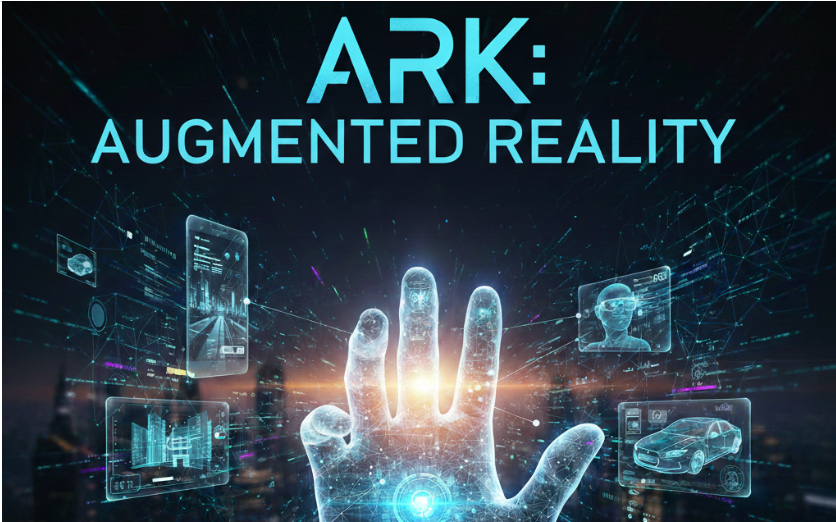

In recent years, augmented reality has shifted from a futuristic idea into a practical, everyday technology. From playful smartphone filters to advanced industrial tools, AR has steadily integrated itself into how we communicate, learn, shop, and entertain ourselves. Among the latest developments shaping this evolution is ARK Augmented Reality, often shortened to ARK AR, a concept that focuses on building immersive digital worlds layered directly onto our physical surroundings.
Unlike traditional digital experiences that trap users behind screens, ARK AR blends virtual elements into the real environment. It transforms streets into game boards, classrooms into interactive labs, stores into virtual showrooms, and workplaces into intelligent spaces filled with real-time guidance. Rather than escaping reality, users enhance it.
As technology grows more powerful and accessible, ARK AR stands out as a glimpse into how humans might interact with the digital world in the near future. It represents not just an upgrade to existing apps, but a whole new way of experiencing everyday life.
What Is ARK AR?
ARK AR refers to augmented reality systems that anchor digital objects permanently or semi-permanently into physical locations. Instead of temporary overlays that disappear when an app closes, ARK AR creates persistent experiences tied to the real world.
Imagine placing a virtual pet in your backyard that remains there every time you open your device. Picture interactive maps hovering above city streets or 3D instructions appearing directly on a machine you’re repairing. These aren’t isolated graphics — they are digital layers that feel integrated into your surroundings.
This approach makes AR feel less like a novelty and more like an extension of reality itself.
Unlike Virtual Reality (VR), which replaces your environment entirely, ARK AR enhances what you already see. You remain aware of your surroundings while interacting with digital information and objects that coexist with the real world.
How ARK AR Works
ARK AR depends on several technologies working together seamlessly. First, cameras scan the environment to understand surfaces and depth. Floors, walls, tables, and objects are detected so digital content can attach naturally to them.
Next, motion sensors track how you move. When you walk around a virtual object, it stays fixed in place, maintaining realistic perspective. This creates the illusion that the object truly exists in the space.
Powerful processors then render 3D models, animations, and lighting effects in real time. Shadows, reflections, and angles adjust automatically to match the real environment, making everything appear believable.
Finally, users interact through touchscreens, gestures, voice commands, or wearable devices like AR glasses. This hands-on control turns passive viewing into active participation.
Together, these components create an experience where the digital and physical worlds blend almost seamlessly.
Changing the Way We Play
Gaming is one of the most exciting applications of ARK AR. Traditional video games take place inside screens, limiting movement and interaction. ARK AR breaks those barriers by using the real world as the game environment.
Players might explore their neighborhoods to discover hidden items, battle virtual creatures in parks, or complete missions tied to physical landmarks. The street becomes the map. The park becomes the arena.
This style of gaming encourages movement, exploration, and social interaction. Instead of sitting alone, players often gather in real spaces to play together. It transforms everyday locations into dynamic adventures.
Because the game world overlaps with reality, the experience feels more immersive and personal. Each player’s environment becomes unique, making every session different.
Reinventing Education
Education is another field where ARK AR offers tremendous benefits. Learning becomes more effective when students can see and interact with what they’re studying.
Imagine a science class where a life-sized 3D solar system floats above desks, allowing students to walk around planets and observe their orbits. History students might witness ancient civilizations reconstructed in their classroom. Medical trainees could practice procedures using holographic guides.
By turning abstract ideas into visual, interactive models, ARK AR helps students understand complex concepts faster and remember them longer.
Hands-on learning increases engagement. Instead of memorizing from textbooks, learners experience lessons directly. This immersive approach can make education both more enjoyable and more effective.
Smarter Shopping and Retail
Retail businesses are increasingly turning to ARK AR to enhance customer experiences. Shopping online often comes with uncertainty — Will the sofa fit? Will those glasses suit me? How will that paint color look on my wall?
ARK AR answers these questions instantly.
Customers can place virtual furniture in their homes, try on clothes digitally, or preview products in 3D. This reduces guesswork and helps buyers feel more confident about purchases.
Stores also use AR to create interactive displays and guided shopping experiences. Instead of browsing passively, customers explore products in engaging new ways.
For businesses, this means fewer returns and happier customers.
Improving Workplaces
ARK AR is also transforming professional environments. In industries like manufacturing, healthcare, and logistics, real-time information can significantly boost efficiency.
Technicians can see step-by-step repair instructions overlaid directly on machines. Warehouse workers receive navigation paths and inventory details through smart glasses. Surgeons view patient data without looking away from procedures.
This reduces errors, speeds up tasks, and shortens training time. Employees spend less time searching for information and more time completing work accurately.
By integrating digital guidance directly into physical tasks, ARK AR makes workplaces smarter and safer.
Creative and Social Uses
Beyond practical applications, ARK AR offers exciting creative possibilities. Artists can design digital sculptures that appear in public spaces. Musicians can add visual effects to live performances. Storytellers can create interactive experiences that unfold around viewers.
Social interactions also change. Friends might leave virtual messages in specific places or share augmented events together. Entire communities could participate in shared digital spaces layered over real cities.
This blend of creativity and technology opens up entirely new forms of expression.
Benefits of ARK AR
Several advantages make ARK AR especially promising. It enhances immersion by blending digital content with reality rather than separating users from it. It’s accessible since many experiences run on smartphones people already own. It boosts engagement because interactive visuals are more compelling than static screens.
It’s also versatile, supporting industries from gaming and education to healthcare and retail.
Perhaps most importantly, ARK AR feels natural. Instead of forcing users into virtual worlds, it enhances the one they already live in.
Challenges Ahead
Like any emerging technology, ARK AR faces obstacles. High-quality experiences require powerful devices and strong internet connections. Battery life can be a concern during long sessions. Privacy issues arise when cameras constantly scan surroundings.
Development costs may also be high for complex applications.
However, as hardware improves and costs drop, many of these challenges will likely fade. Smaller, lighter devices and better software will make AR even more practical.
The Road Forward
The future of ARK AR looks bright. As smart glasses replace smartphones and networks become faster, augmented experiences may become part of daily life. Directions, notifications, and information could appear directly in our field of vision. Work, play, and communication might all happen through immersive overlays.
Eventually, the difference between “online” and “offline” could disappear.
ARK AR represents a step toward that reality — a world where digital content doesn’t live inside screens but exists all around us.
Conclusion
ARK AR is more than a technological trend; it’s a new way of interacting with the world. By layering digital experiences onto physical spaces, it transforms how we learn, work, shop, and play. From immersive games to smarter workplaces and interactive classrooms, the possibilities are vast.
As technology continues to evolve, ARK AR may become as common as smartphones are today. And when that happens, our surroundings won’t just be places we move through — they’ll become living, interactive spaces filled with information and opportunity.